

February 20, 2024
On 23 January 2024, Finnish stakeholders gathered in Helsinki to discuss credible climate claims, focusing on the demand for contribution claims based on domestic carbon credits. The event was organised jointly by Perspectives Climate Research, Tyrsky Consulting and the Finnish Chamber of Commerce. It is part of Nordic project on building capacity for voluntary carbon markets, funded by the Nordic Council of Ministers.
The event was opened by Teppo Säkkinen, Senior Advisor for Industrial and Climate Policy from the Finnish Chamber of Commerce. The Chamber of Commerce aims to promote functioning markets and fair competition, corporate responsibility and cost-effective, market-based climate action. For example, they have a Council of Ethics in Advertising and a Board of Business Practice. The Chamber has also recently launched a programme to support climate action by small- and medium-sized enterprises (SMEs), which together with insurance and investment company LähiTapiola. In his welcome speech, Teppo noted that carbon credits have a role in many companies’ climate work. Therefore, this event would focus on the demand for high-integrity carbon credits that are generated in Finland or elsewhere in the EU and are suitable for contribution claims and supporting host country targets, in line with good practices.
Hanna-Mari Ahonen, Senior Consultant at Perspectives Climate Research, introduced good practices for climate claims that are based on carbon credits. She explained how emission reductions and removals that meet relevant minimum criteria can be certified as carbon credits and used for voluntary or compliance purposes. Using carbon credits voluntarily in line with good practices can help to achieve the Paris Agreement’s global 1.5-degree goal by contributing either to national climate targets or to mitigation beyond these targets. Good practices require, inter alia, reducing own value chain emissions in line with science, using only high-integrity carbon credits, reporting transparently and comprehensively and making only credible claims. Currently, carbon credits generated in Finland and the EU can contribute to the Finnish and EU climate targets and serve as a basis for contribution claims.
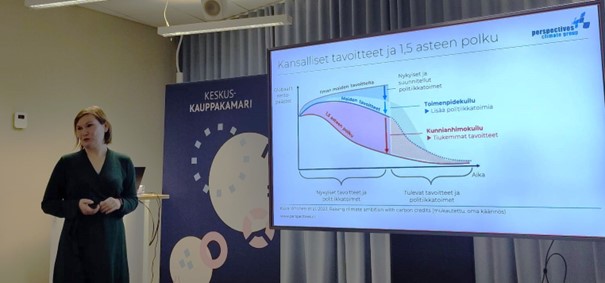
Photo by Emilie Yliheljo
Domestic carbon markets have potential but more regulation and guidance is needed to make them work, said Suvi Järvinen, senior specialist on the climate and environment at LähiTapiola, a Finnish insurance and investment company. LähiTapiola aims for carbon neutrality of its own operations by the end of 2025 and for a net-zero investment portfolio by 2050. While science-based reductions in own emissions are prioritised, LähiTapiola expects some emissions to remain and be addressed by buying carbon credits from the voluntary carbon market. LähiTapiola has an interest in domestic credits, since they are easier to understand and communicate, but also identified the need to avoid double claiming as a key challenge for current domestic markets. Suvi noted that, as awareness is rising, some companies are looking to adjust their climate targets and related communication to enable the use of domestic credits in a way that avoids double claiming. She also highlighted that many of LähiTapiola’s clients, including farmers and forest owners, can have a key role in providing climate solutions, including through the voluntary carbon market. LähiTapiola is motivated to be part of the solution, also by supporting the development of a credible domestic market. Finally, Suvi stressed that trust is a critical precondition for engaging in markets, especially for entities like LähiTapiola that operate in a highly regulated environment. They must comply with requirements and apply good practice, and they cannot take risks that could undermine their credibility. LähiTapiola calls for cooperation to further develop regulation and guidance so that the domestic carbon markets could truly contribute to climate targets and we could agree on common ways to communicate about it.
SMEs struggle to navigate the voluntary carbon market guidance and (mis)information, stressed Jussi Tamminen, founder and CEO of Maku Brewing, a small Finnish craft beer brewery. Since their launch, Maku Brewing has been seeking climate-smart solutions in their operations, such as using emission-free electricity and biogas for transport. They implement a new emission reduction activity each year. In addition, since 2020, Maku Brewing has calculated its value chain emissions and bought an equivalent amount of carbon credits to make their operations carbon neutral. For an SME, the costs relating to calculating carbon footprints and building carbon credits is disproportionally high compared with the potential benefits, which are limited only to marketing and communication. Finance and insurance providers have not taken carbon neutrality into consideration. Besides being the only upside, marketing also comes with risks of negative press and accusations of greenwashing. Jussi noted that guidance is often targeted at larger companies and there is a lot of unhelpful “noise” about the voluntary carbon markets. For an SME, it is very challenging to know which information and advice to trust when engaging in these markets.
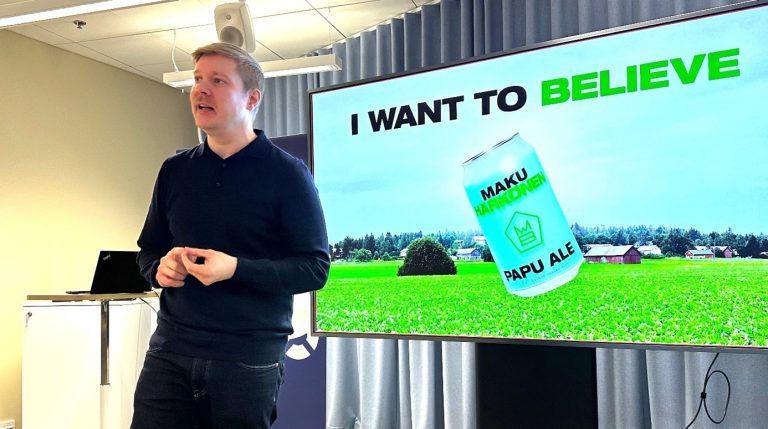
Photo by Hanna-Mari Ahonen
Domestic credits are attractive to companies with a domestic client base, said Terhi Naukkarinen, sustainability manager at SOK, which is part of a Finnish network of companies in the retail and service sectors. Ninety per cent of their value chain emissions occur in scope 3, related to groceries and transport fuels. SOK’s current climate targets focus on their own operations, but include also goals that could change consumer behaviour and thus reduce scope 3 emissions, e.g. through increasing the share of plant-based groceries. SOK is also planning to set a net zero target for 2050, including targets for scope 3 emissions. In this context, the calculation of Forest, Land and Agriculture (FLAG) emissions is especially complex. Although the focus is on prioritising value chain emission reductions, carbon credits can also play a role in achieving the climate targets. Given their domestic client base and strong local presence, SOK has a strong interest in domestic credits and is following the market closely.
Voluntary support for domestic climate action is very important for meeting Finland’s climate targets, concluded Karoliina Anttonen, Senior Ministerial Adviser, Legal Affairs for the Finnish Ministry of the Environment. She stressed that the government of Finland is responsible for all emissions that occur within its boundaries, and further domestic climate action is needed to meet the ambitious national climate target. She called for domestic voluntary carbon markets to contribute to the national target.
The workshop focused on the demand for domestic carbon credits and related contribution claims. Participants discussed the following questions:
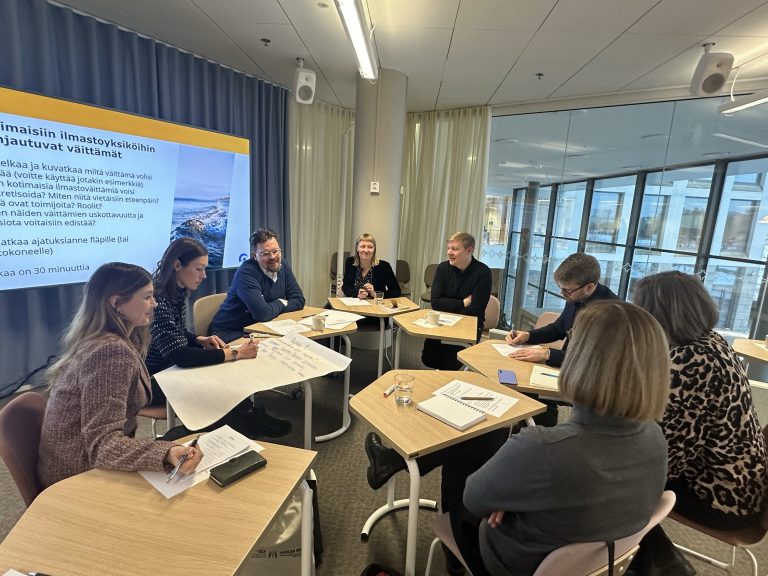
Photo by Hanna-Mari Ahonen
Regarding domestic carbon credits, participants noted that:
Regarding contribution claims, participants noted that:
The role of the Finnish Chamber of Commerce should be explored, e.g. Council of Ethics in Advertising, Board of Business Practice and support programme for SMEs’ climate work
The recording of this event can be found here.
| Cookie | Duration | Description |
|---|---|---|
| cookielawinfo-checkbox-analytics | 11 months | This cookie is set by GDPR Cookie Consent plugin. The cookie is used to store the user consent for the cookies in the category "Analytics". |
| cookielawinfo-checkbox-functional | 11 months | The cookie is set by GDPR cookie consent to record the user consent for the cookies in the category "Functional". |
| cookielawinfo-checkbox-necessary | 11 months | This cookie is set by GDPR Cookie Consent plugin. The cookies is used to store the user consent for the cookies in the category "Necessary". |
| cookielawinfo-checkbox-others | 11 months | This cookie is set by GDPR Cookie Consent plugin. The cookie is used to store the user consent for the cookies in the category "Other. |
| cookielawinfo-checkbox-performance | 11 months | This cookie is set by GDPR Cookie Consent plugin. The cookie is used to store the user consent for the cookies in the category "Performance". |
| viewed_cookie_policy | 11 months | The cookie is set by the GDPR Cookie Consent plugin and is used to store whether or not user has consented to the use of cookies. It does not store any personal data. |